On the evening of October 10, the ‘2nd Belt and Road Forum for the Advancement of China-Bangladesh Relations-2026’ was held on Tencent’s online platform. The forum’s theme was ‘Inclusive and Interconnected Sustainable Development.’ It brought together participants to explore opportunities for bilateral cooperation in education, health care, sustainable fashion, industrial automation, technology, trade, and cultural exchange. Professor Tao Hui delivered a keynote speech titled ‘Sustainability for Whom? Sustainable Design from an Inclusive Perspective.’ The School of Fashion at Wuhan Textile University co-organized the forum, reflecting its focus on educational development in Belt and Road countries.
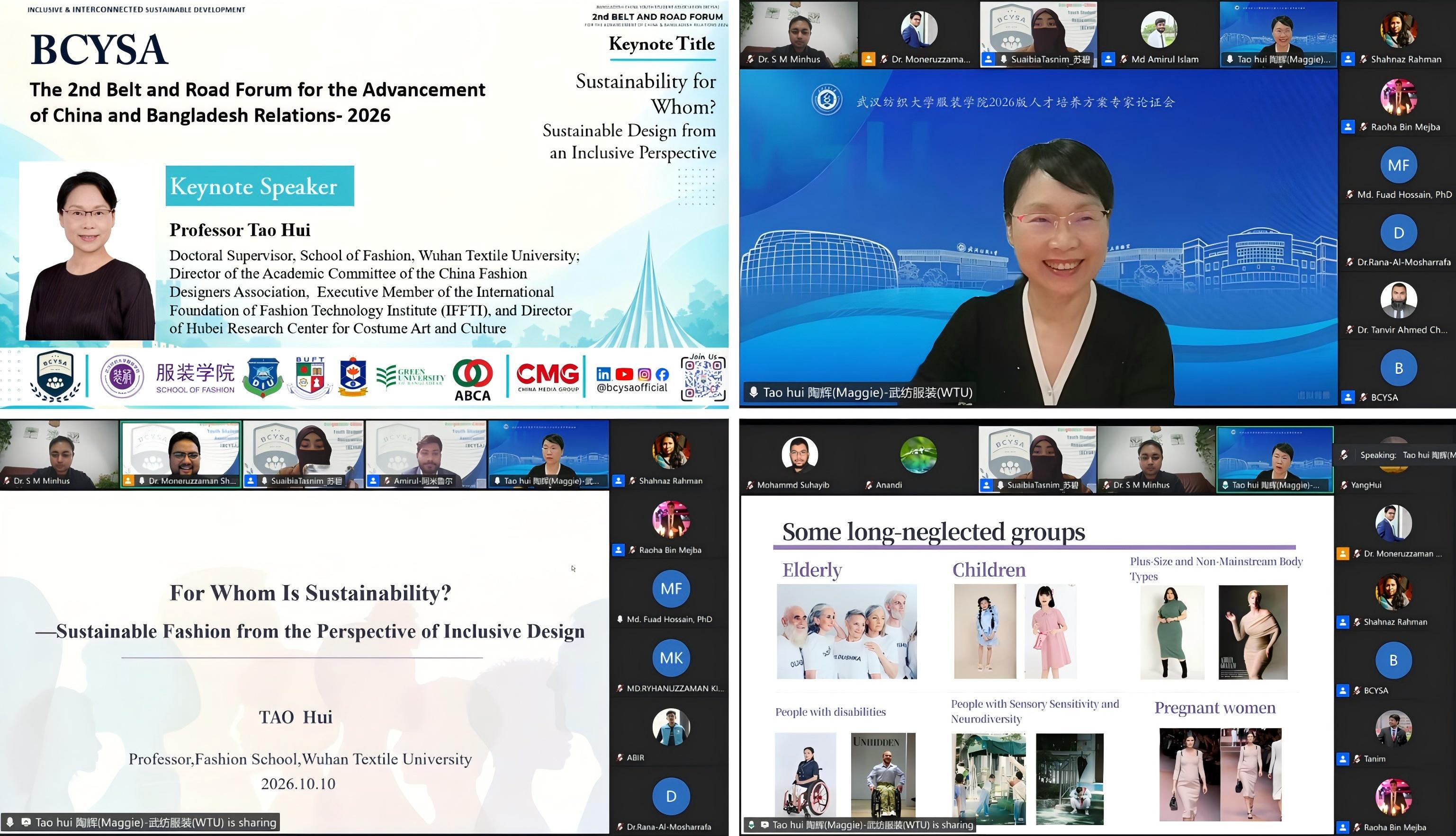
(Professor Tao Hui delivering her keynote speech during the forum)
During her speech, Professor Tao Hui emphasized that the School of Fashion at WTU is actively collaborating with countries along the Belt and Road to advance educational development and promote sustainable growth in the fashion industry. The School of Fashion at WTU has participated in this forum since last year. She noted that the education system can play a vital role in ensuring the long-term success of sustainable fashion. She added that, as we pursue cross-cultural cooperation, we must invest in knowledge-sharing programs that promote understanding of sustainable fashion practices across borders. Addressing cross-cultural issues, she observed that each forum member has a role to play in advancing the Belt and Road Initiative and fostering sustainable practices across countries, cultures, and industries.
The discussion on ‘Sustainability for Whom?’, presented by Prof. Tao Hui, focused on inclusive design, particularly the needs of older adults and individuals with non-standard body types, and on integrating inclusive design principles into fashion education. This topic is especially relevant to Bangladesh and China, both of which have significant interests in the textile and apparel industry. Bangladesh’s garment manufacturing and export capacity, combined with China’s expertise in textile technology, manufacturing, and design, could create opportunities for collaboration in sustainable production, innovative clothing design, and professional training. Such cooperation could help both countries respond to evolving international market expectations while promoting more inclusive and environmentally responsible practices.
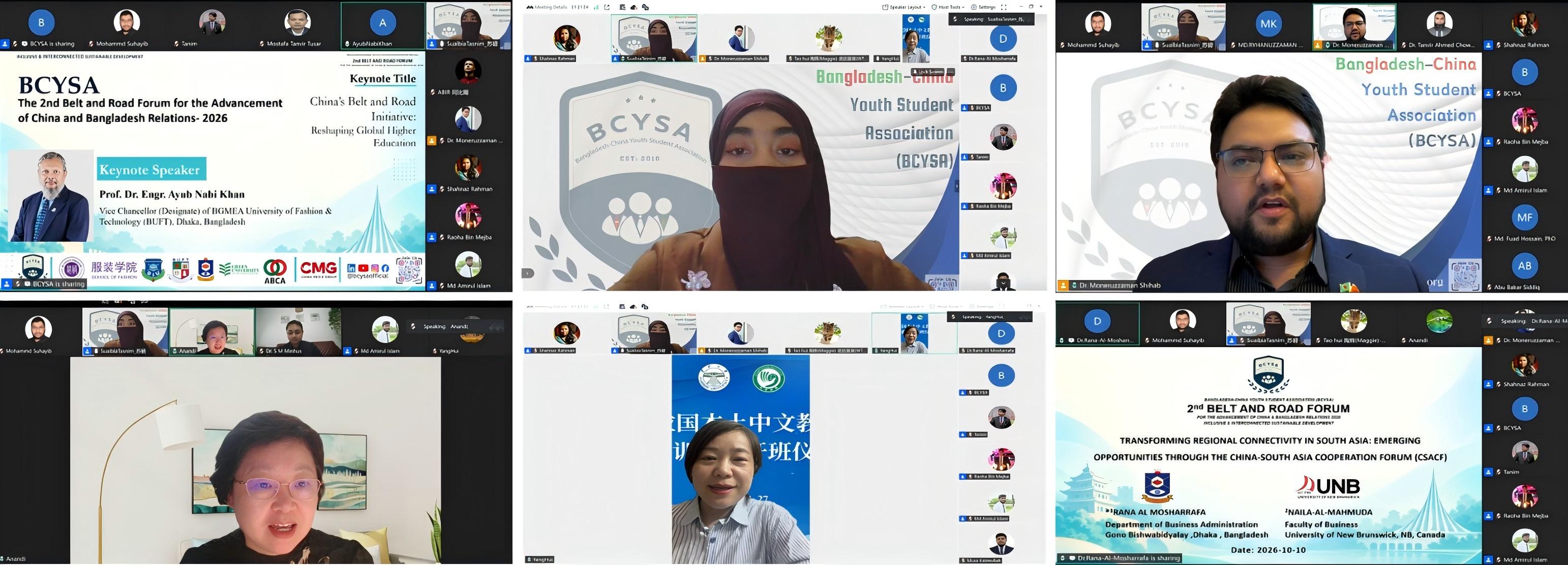
(Keynote speakers from Bangladeshi and Chinese universities and the BCYSA president deliver their speeches)
To gain new ideas and broaden perspectives, five professors from universities in China and Bangladesh served as keynote speakers, while three special guests and five presenters shared innovative proposals to strengthen relations between the two countries. The keynote speakers included Professor Tao Hui; Dr. Md. Fuad Hossain, Dean of the Faculty of Health Sciences at Gono Bishwabidyalay, Bangladesh; Dr. Engr. Tanvir Ahmed Chowdhury, Associate Professor and Head of the Department of Textile Engineering at Daffodil International University, Bangladesh; and Prof. Dr. Engr. Ayub Nabi Khan, Vice Chancellor (Designate) of BGMEA University of Fashion & Technology (BUFT), Dhaka, Bangladesh. The special guests included Prof. Dr. Md. Shahabul Haque of the Department of Political Studies at Shahjalal University of Science and Technology, Sylhet, and General Secretary of the Association of Bangladesh China Alumni (ABCA); Dr. Yang Hui, Director of the Confucius Institute at the University of Dhaka, Bangladesh; and Yu Guang Yue, Director of the Bengali Department at China Media Group. BCYSA President Dr. Moneruzzaman Shihab also shared insights on promoting cooperation. The forum highlighted potential avenues for Bangladesh–China cooperation across multiple sectors, including joint research, educational exchange, industrial modernization, sustainable production, healthcare development, and technological innovation. By bringing these topics together under the theme of inclusive and interconnected sustainable development, the event provided a platform for exploring practical partnerships to support shared priorities, strengthen institutional connections, and deepen people-to-people relations between Bangladesh and China.
Dr. Yang Hui of the Confucius Institute at the University of Dhaka discussed Chinese-language education in Bangladesh, the shortage of qualified language teachers, and the need for local teacher training. Ms. Yu Guang Yue also addressed the role of media and cultural engagement in fostering mutual understanding. These areas are significant because language proficiency and cultural awareness can help students, researchers, and professionals build stronger cross-border connections. Expanded cooperation among universities, language institutes, and cultural organizations could facilitate student exchanges, academic partnerships, and professional development. In a keynote address, Prof. Dr. Ayub Nabi Khan, Vice Chancellor of BUFT, examined the broader influence of the BRI on global higher education and identified opportunities to strengthen academic cooperation between Bangladeshi and Chinese institutions through joint research, faculty exchanges, shared academic resources, and collaborative training programs. The forum also explored opportunities in textile heritage, fashion innovation, and digital education. Dr. Tanvir Ahmed Chowdhury, Associate Professor at Daffodil International University, discussed textile and fashion cooperation, highlighting the complementary strengths of the two countries and proposing academic exchanges, joint research, and design initiatives that integrate traditional craftsmanship with contemporary innovation. As the forum's initiator, Dr. S M Minhus, a foreign faculty member of the School of Fashion at WTU, delivered special remarks to the esteemed guests and proposal presenters, emphasizing the importance of institutional cooperation and proposing future cross-border cultural research projects. Dr. S M Minhus also served as BCYSA vice president and team leader of the Belt and Road Training Academy.

(Dr. S M Minhus, a foreign faculty member of the School of Fashion, delivered special remarks to the speakers and the audience)
For over 12 years, the School of Fashion has developed collaborations on sustainability education with more than ten international universities. These collaborations have established a strong foundation and encouraged enthusiasm for pursuing broader and deeper collaborations in sustainability education. In the future, the fashion school will place greater emphasis on collaborating with countries along the Belt and Road in areas such as cooperative research, sustainable fashion education development, and school-enterprise cooperation for talent cultivation.
(Note: The Bangladesh-China Youth Student Association (BCYSA) is a welfare organization and social platform. Its purpose is to promote the philosophies, cultures, and policies of both countries while fostering a positive relationship through all possible effective activities. Members of BCYSA aspire to be dedicated and visionary ambassadors of China in Bangladesh, working to enhance cooperation between the two nations and deepen understanding among the people of these two great, friendly countries, all while representing the legitimate aspirations and rights of Bangladeshis living in China. BCYSA platform https://www.bcysa.org/aboutus)